
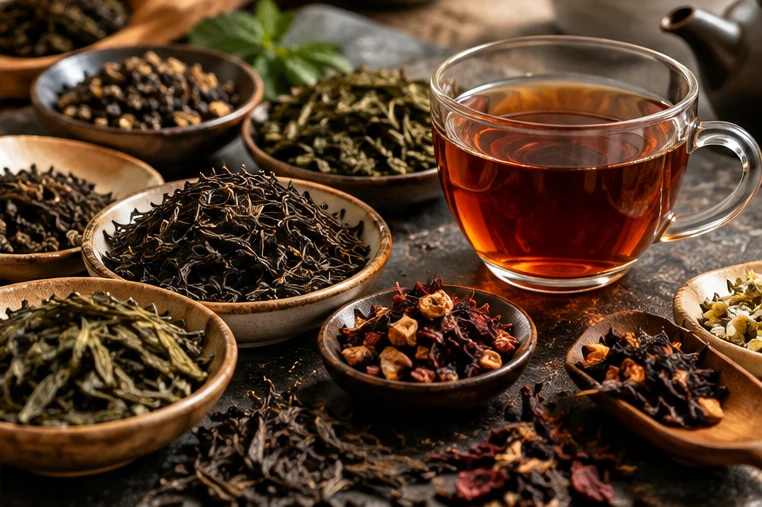
“Green tea has less caffeine than black tea” can be a useful generalisation, but not a dependable rule for any specific cup. Tea type, dose, brewing conditions and serving size all matter.
Traditional practice and popular belief are reported as cultural context, not clinical proof. Studies of capsules, oils or concentrated extracts do not establish identical effects from a brewed drink. Sources below are available to check; this page has not undergone independent clinical peer review.
Start with the plant
Every conventional green, white, yellow, oolong, black and dark tea comes from the naturally caffeine-containing Camellia sinensis plant. Some caffeine-free infusions are made from unrelated plants like chamomile, rooibos and peppermint.
Matcha is made from powdered true tea, and the whole powder is consumed. Its caffeine depends on how much powder is used—not merely on whether the liquid looks pale green.
Why published figures differ
The U.S. FDA gives illustrative typical figures of about 37 mg caffeine in a 12-fluid-ounce green tea and 71 mg in a 12-fluid-ounce black tea, but explicitly notes variation by product and portion. Those numbers do not justify assigning the same value to every sencha, gongfu oolong or breakfast blend.
A teaspoon of densely rolled leaves and a teaspoon of fluffy leaves are not the same mass. Brewing multiple infusions and varying water temperature affect caffeine extraction, but neither first-rinse rituals nor cold-brewing necessarily produce zero caffeine.
Decaf is not the same as none
Decaffeinated tea has had most caffeine removed, but traces can remain. Herbal infusions may be naturally caffeine-free if the blend has no caffeinated ingredients. Yerba mate, guayusa and yaupon are herbal beverages that do contain caffeine.
The safest way to avoid caffeine completely is to verify both the plant source and any additional ingredients—not to choose by package colour.
What is a reasonable amount?
The FDA cites around 400 mg per day as an amount not generally associated with adverse effects for most healthy adults, but individual sensitivity and medical conditions change what is suitable. Pregnant people generally receive stricter advice; the UK NHS advises no more than 200 mg daily.
These figures are not targets, and someone with sleep disruption or palpitations may need less. Children and teenagers have separate considerations.
Tea timing and sleep
Caffeine can remain active for hours, and personal sensitivity differs. Rather than promising an exact universal “last cup” time, use your experience and healthcare advice. If your sleep is disrupted, try moving caffeine earlier or choosing a naturally caffeine-free evening infusion.
Herbal evening drinks are not proven insomnia treatments; removing caffeine simply avoids one potential sleep-disrupting input.
Checking a specific tea
Look for a manufacturer-tested caffeine value where available, the serving size used, the brewed amount, the leaf-to-water ratio and whether the product is true tea or botanical. Avoid precise milligram claims when there is no laboratory or reliable label evidence.
Questions readers ask
Is matcha caffeine-free?
No. It is powdered green tea and contains caffeine.
Is roasted hojicha caffeine-free?
No. It may have a reputation for lower caffeine, but not all servings are low and it is not zero.
Is decaf tea absolutely caffeine-free?
No. Decaffeination removes most caffeine, not necessarily all of it.
Sources and further reading
Public-health references supporting the major claims. OngTeh has paraphrased these sources and identified form/dose limitations.